- "500 ps" is a category label: real platforms range from 300 to 900 ps. Ask for a measured value with a tolerance and an oscilloscope trace, not a round number.
- Millijoules mean nothing without spot size. 2000 mJ is roughly 64 J/cm² at 2 mm and 2.5 J/cm² at 10 mm — ask for fluence at your working spot, held for a full day.
- A genuine 755 nm channel is a second cavity with its own energy spec. If it costs the same as a two-wavelength unit, it is a filter or a de-contented 1064 side.
- Throughput is bought in hardware, not in the menu: an 8 mm spot at 10 Hz is roughly thirty times faster per pass than 2 mm at 5 Hz.
Every second email we get about tattoo removal arrives with a brochure showing three numbers on the front page: 2000 mJ, 500 ps, 1064/532/755 nm. Nearly every supplier prints the same three, and the machines behind them are not the same machine. One clears a black sleeve in five or six sessions. The other leaves a grey ghost and a review you cannot delete.
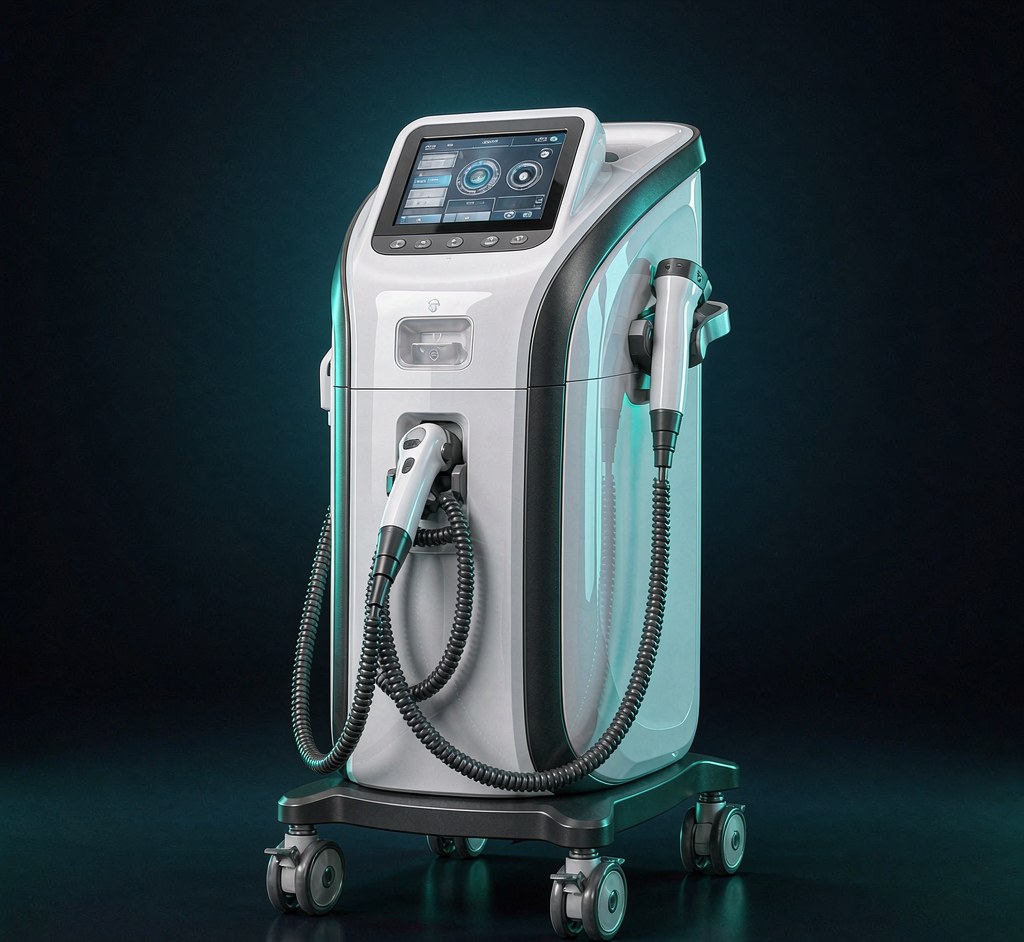
We build the PSL-A platform and also service units that came from elsewhere. This is the list of parameters we would interrogate if we were spending our own money on a picosecond laser tattoo removal machine — ordered by how much each one changes the result in the room.
Pulse width is a range, not a badge
Q-switched Nd:YAG platforms deliver 5 to 10 nanosecond pulses. Picosecond platforms deliver somewhere between 300 and 900 ps, and the industry has quietly agreed to call all of that "picosecond". The badge on the front panel tells you the category. It does not tell you the performance.
What matters is where the pulse sits against the thermal relaxation time of the pigment particle. Above a nanosecond, energy diffuses away as heat: frosting, heat spill into surrounding tissue, slower clearance. Below it, energy is deposited faster than heat can escape, and photoacoustic pressure breaks the particle into fragments small enough for the body to carry off.
Ask for three things before you accept the number:
- A measured value with a tolerance — "500 ps ± 20 ps, measured at the output" is an answer. "Ultra-short picosecond technology" is not.
- Where it was measured. Oscillator pulse width and delivered pulse width are different numbers once the beam has travelled down an articulated arm.
- An oscilloscope trace. Any factory with a photodetector can produce one in ten minutes. If nobody can, the figure came from a component datasheet, not from the unit you are buying.
One honest caveat: shorter is not automatically better on every ink. Very high peak power on light cosmetic pigment, or on ink containing titanium dioxide, can make a tattoo come back darker instead of lighter. That is a protocol problem, not a hardware one — but it is why you test-spot before promising a session count.
Match the wavelengths to the ink on your table
Wavelength decides which pigment absorbs the pulse. Every platform has 1064 and 532 nm, because both come from one Nd:YAG crystal and its frequency-doubled output. The third wavelength is where quotations quietly diverge.
| Wavelength | Absorbed by | Used for | What to verify |
|---|---|---|---|
| 1064 nm | Black, dark blue, dark green | The bulk of tattoo work, plus dermal pigment | Energy at the largest spot, not just at 2 mm |
| 532 nm | Red, orange, brown | Warm-colour ink, superficial pigment, freckles | Whether energy is quoted separately or inherited from 1064 |
| 755 nm | Blue, green, some teal | The colours that 1064 and 532 both handle badly | Whether it is a real second cavity or a filter on the 1064 beam |
| 585 / 650 nm | Light blue, sky blue, green | Optional add-ons for stubborn cool tones | Delivered energy at that wavelength, and how many handpieces |
| 1320 nm | Water in tissue | Rejuvenation protocols, not ink | Whether you need it at all — most buyers do not |
A 755 nm channel is a second cavity and a second set of optics, and it costs real money to build. If a supplier offers "1064/532/755" at the price of a two-wavelength unit, one of three things is true: the 755 is a filter, its energy is a fraction of the headline figure, or the 1064 side was de-contented to pay for it. Ask for the energy table per wavelength and spot size. A manufacturer sends it; a trading company sends a brochure.
Energy, spot size and fluence: why "2000 mJ" alone means nothing
Millijoules are energy per pulse. Fluence — joules per square centimetre — is what the ink actually experiences, and it is that energy divided by the area of the spot.
| Spot size | Area | Fluence from a 2000 mJ pulse | What it means in the room |
|---|---|---|---|
| 2 mm | 0.031 cm² | ~64 J/cm² | Far above any tattoo setting; for precise pigment work at reduced energy |
| 5 mm | 0.196 cm² | ~10 J/cm² | Top of the useful range |
| 8 mm | 0.503 cm² | ~4 J/cm² | The realistic working window for most tattoo passes |
| 10 mm | 0.785 cm² | ~2.5 J/cm² | Large-area work where speed matters more than peak fluence |
So the useful question is never "how many mJ". It is: what fluence does this unit hold at 8 mm and at 10 mm, and for how long? A machine that reaches 2000 mJ in single-shot mode and settles at 1200 mJ after ten minutes of continuous firing has a 2000 mJ datasheet and a 1200 mJ clinic. Ask for a ten-minute run at your working setting with the energy read before and after. If there is no drift figure, there is no specification — only a maximum.
What actually separates a budget platform from a clinical one
| Entry platform | Clinical platform | Why it matters | |
|---|---|---|---|
| Cavity | Single rod, single lamp | Double rod, double lamp | Headroom at a large spot comes from the cavity, not from the firmware |
| Beam profile | Gaussian — hot centre, weak edge | Homogenised, flat-top | A Gaussian spot over-treats the centre and under-treats the rim: patchy clearance and a hot point you cannot see |
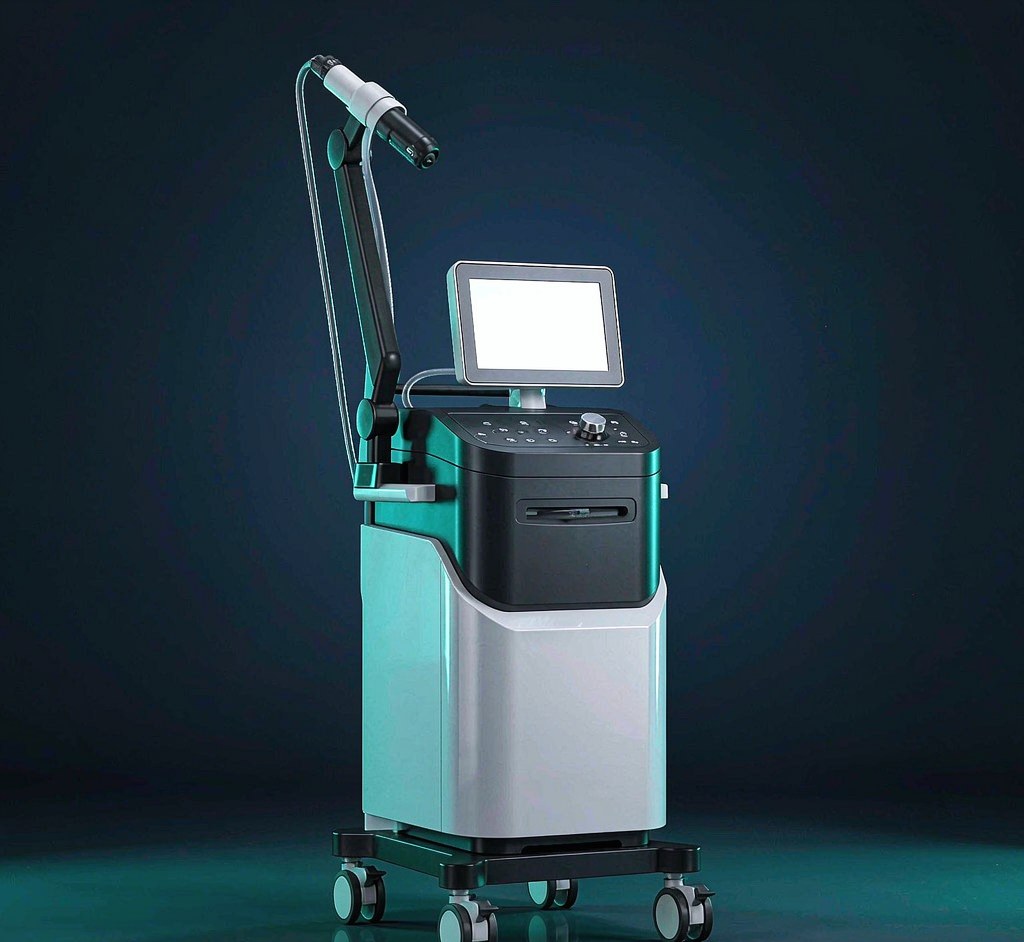
| Arm | 6-joint, spring-loaded | 7-joint with counterbalance | Alignment drift changes spot shape over months; a drifting arm is a burn waiting for a busy day |
| Cooling | Air only, or a small water circuit | Closed-cycle water-to-air | Duty cycle. An air-cooled unit derates through the afternoon; a water-cooled one keeps its number |
| Energy feedback | Display shows the setpoint | Display shows measured output | A setpoint is a wish. A measurement is a specification |
| Documentation | One certificate for the model | Test report per serial number | It is what your importer, your insurer and your regulator will ask for |
Modes: what SP, PTP and the rest actually change
Mode names are not standardised across brands, which is precisely why they are convenient to hide behind. In practice most platforms ship four behaviours:
- Single pulse (SP) — full energy in one shot. Maximum peak power, best on dense black and old ink, highest risk of epidermal injury if fluence is set by enthusiasm rather than protocol.
- Pulse-to-pulse (PTP) — the pulse splits in two with a microsecond-scale gap so the epidermis sheds heat between them. Higher total fluence, less frosting, less downtime. Ask what the gap adjusts to; if nobody knows, it is fixed in firmware.
- Long pulse — energy stretched into heat. Vascular and some benign pigmented lesions, not tattoo ink.
- Multi-pulse / rejuvenation — low-fluence, high-repetition passes for tone and texture. Nice to have, not why you buy the machine.
If your case mix is mostly black and dark ink, SP and PTP at 1064 nm carry the revenue. Do not pay a premium for modes you will never select; put that money into the cavity and the arm. And if texture and scarring are the real demand in your market, you want a different device — look at our CO2 fractional laser before spending a picosecond budget on a resurfacing problem.
Throughput: the number that decides whether it pays back
Spot size and repetition rate together set session length, and session length sets how many bookings fit in a day. Take a 10 × 10 cm tattoo — 100 cm² — and one pass:
- 2 mm spot at 5 Hz covers about 0.16 cm² per second: roughly ten minutes of laser time per pass, before overlap.
- 8 mm spot at 10 Hz covers about 5 cm² per second: about twenty seconds per pass.
That is a thirty-fold difference in chair time, and the main reason two machines with identical brochures earn differently. The catch: holding fluence at 8 mm needs far more pulse energy than at 2 mm, which needs the bigger cavity. Speed is not a menu setting. It is bought in the hardware.
And budget the thirty to forty-five minutes of topical anaesthetic before each session. On session one, that is the bottleneck — not the laser.
A twenty-minute demo you can run before you pay
Ask for a live video call with the unit powered on and run this yourself, not a prepared clip:
- Fire on thermal paper at 2, 5 and 8 mm. The marks should be round and even in density; an oval or a comet shape means the arm is out of alignment.
- Ask for the oscilloscope trace at the setting you will actually use, not at maximum.
- Run ten minutes continuously at 8 mm and 8 Hz, then read the energy again.
- Compare display and measured output if there is an external energy meter.
- Sweep the arm through its full range and watch whether the spot stays centred.
- Request the test report for that serial number and match it to the chassis.
None of that needs a physics degree and all of it fits in one call. Suppliers who build properly enjoy this demo. Suppliers who do not will offer you a discount instead — which tells you what you needed to know.
Red flags we would walk away from
- "No eye protection needed." For any Class 4 laser, that is disqualifying on its own.
- No test report per unit — only a certificate for the model.
- A price below what a double-cavity platform costs to build, with no explanation of what was removed.
- "Complete removal in three sessions" for any ink, colour or skin type. The supplier who promises that will not answer the phone when your client asks for a refund.
If your market is almost all black and grey work, a good Q-switched Nd:YAG platform at a third of the price does most of the job, and the picosecond premium buys speed and comfort rather than a different outcome. If colour is common where you sell — and in most of Europe, Latin America and Southeast Asia it is — the picosecond platform with a real 755 nm cavity is the one that stops turning work away.
Bottom line
The parameters that decide a picosecond tattoo removal machine are, in order: measured pulse width with a tolerance, a real 755 nm cavity if you sell into colour-heavy markets, fluence held at 8 to 10 mm for a full clinic day, a flat-top beam, and an arm that stays aligned. Everything else on the brochure — mode names, screen size, cabinet design — is decoration.
If you send us the ink mix you see most and the session price you charge, we will tell you which configuration that supports and which line item you can delete, including the cases where we would tell you not to buy a picosecond machine at all. That answer is free, and it is the same one we would give a friend: gaojiping@xhlmarketing.com.