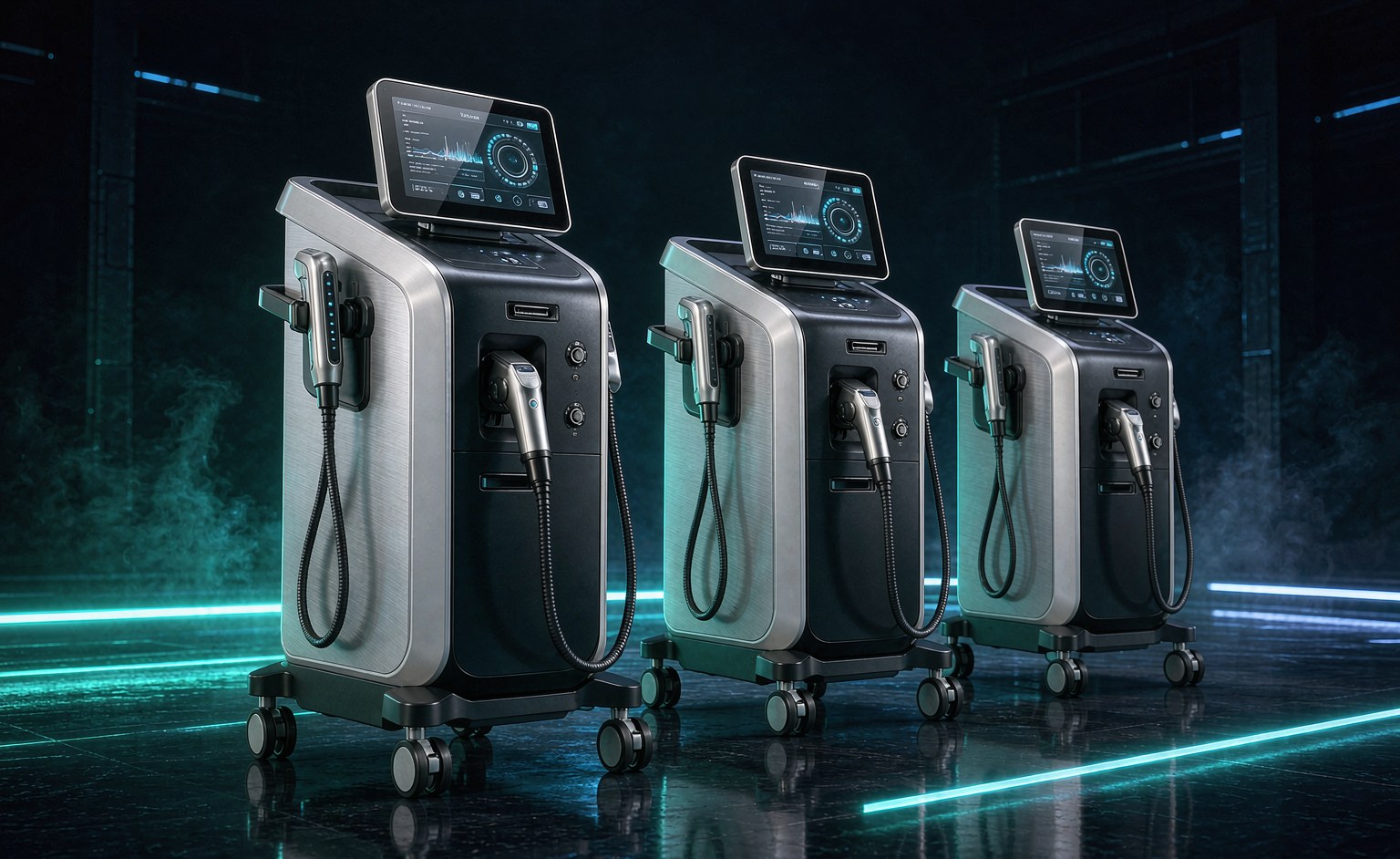
- A sample is a paid audit of the supplier, not a cheap machine — judge it on a month of your own clinic data, not on a demo pulse.
- Put the sample's full configuration, serial number and test sheet in writing; that document becomes the spec for the bulk order.
- Run the machine hot and for long days — thermal drift and cooling problems only appear under real workload.
- Quote the test log in the purchase order and make the batch conditional on it: 'to match the sample as tested' prevents most disputes.
Buying one machine before you buy twenty is the cheapest insurance in this industry. Most buyers still run the sample wrong: unbox it, fire a few shots at a colleague's arm, declare it validated, then place a container order weeks later — and the units that arrive are not the unit they tested.
We ship sample units to clinics and distributors almost every week. This is the protocol we would run ourselves if we were the ones paying: what a sample can prove, what it cannot, and how to turn a good test into an order that does not change underneath you.
What a sample unit is actually for
A sample is not a discounted machine. It is a paid audit of the supplier, carried out in the only place that matters: your treatment room, with your operators, on your patients' skin types. A showroom can prove a machine switches on. Only your clinic can tell you whether it earns.
Three questions a sample answers that no video call can:
- Does output hold up over a working day? Not the first pulse on a cold machine, but hour three, at the room temperature your clinic actually runs at.
- Do your operators like it? Treatment speed and interface logic decide whether your staff use the machine happily or quietly avoid it.
- How does the supplier behave when something goes wrong? The first shipment tells you what year three will feel like.
Everything else — price, certificates, warranty wording — is a document you can read before you pay. Behaviour is not.
Sample, inspection, or factory acceptance test?
These are three different risk controls. A sample tests the design and the relationship. An inspection tests the shipment. A factory acceptance test tests your own serial number. Pick the one that matches the risk you are carrying.
| Control | What it proves | What it cannot prove | When to use it |
|---|---|---|---|
| Sample unit, shipped to your clinic | Clinical performance, operator fit, real after-sales behaviour | Consistency across a full production run | New supplier, new model, first order |
| Third-party pre-shipment inspection | Quantity, packing grade, cosmetics, conformity to spec | Whether it still performs in month six | Repeat order of a model you already run |
| Factory acceptance test on your serial number | That the unit shipping to you powers up, delivers energy and passes its test sheet | Long-term reliability — one hour is not a year | Every order, as the final gate |
| Two or three units from stock | Whether different production batches behave identically | Anything about a configuration nobody has built yet | Scaling from a few units to a full batch |
The sequence that works for a first order: sample first, then a factory acceptance test on every unit after that. Skipping the sample saves one machine and risks the whole order.
Paying for a sample without paying twice
Samples normally cost more per unit than the bulk price, and that is not a trick: one unit carries engineering time, test time, export packing and air freight that a pallet of twenty spreads across many machines. Treat the premium as a research fee — and make it a fee that converts.
Before you pay, get three things in writing:
- The full configuration, item by item. Model, wavelength, how power is defined and where it is measured, spot sizes, cooling type, software version. This document, not the marketing page, becomes the spec for the bulk order.
- The credit terms. Many factories credit part of the sample price against the first bulk order. Ask what the condition is — usually a minimum quantity within a set period — and have it printed on the proforma invoice.
- The serial number and the test sheet. These become the baseline you compare every later unit against.
If a supplier will not state in writing where and how power is measured, the sample is not measurable and your test becomes an opinion. Treat that as a red flag on its own.
Incoming inspection: the first 90 minutes
Film the unboxing. It is the only evidence that survives if the crate arrived damaged and the insurer asks what was inside it.
- Outer crate, straps and shock indicators. Photograph everything before you remove anything. Damage is a conversation to have immediately, not after installation.
- Accessories against the packing list. Count eyewear, handpieces, tips, footswitch, keys, fuses, water tubing and the manual — missing accessories are the most common first-shipment issue.
- Nameplate and serial number. Confirm they match your invoice and the factory test sheet.
- Handpiece and connectors. Scratches, or a connector clearly mated hundreds of times, means the unit is not new.
- Certificates, if you paid for them. The model number on the document must match the machine. If it names a different model, stop and ask now, while you still hold the balance on the bulk order.
- Cooling and water. Fill, bleed and run for 20 minutes, watching for leaks, unusual pump noise and condensation around the optics window.
The 30-day test protocol
A single demonstration proves almost nothing. You want a month of data across the skin types you actually treat, collected by the staff who will operate the machine.
- Days 1–3: bench checks. Run the machine through its full parameter range. Verify output at the handpiece with a meter if you can borrow one, and confirm the treatment modes you were promised are present and unlocked — not "available as an option".
- Days 4–10: supervised treatments. Your most experienced operator runs real patients at conservative settings, logging energy, spot size, pulse duration and skin type for every session.
- Days 11–20: full working load. Treat at your normal volume and deliberately schedule one long day. Thermal drift and cooling capacity only show up when the machine is hot. This is where a diode platform either holds its parameters or quietly drops output — a diode laser such as the 4-wavelength DL-D20 should deliver the same fluence at 5 p.m. as at 9 a.m. If it does not, you have found the most expensive defect in your order while you can still walk away.
- Days 21–25: the uncomfortable tests. Restart mid-treatment. Switch it off, let it cool overnight, run it again. Ask what happens if the water level drops and what each error code means. A machine that fails safely beats one that fails dramatically.
- Days 26–30: harvest the data. Average the log, compare it with the supplier's claims, write down every question, then send them all at once and time the reply.
If your sample is a pigment platform rather than a hair removal unit, run the same sequence on test pigment: a picosecond system should clear a standard patch in a predictable number of sessions, and a CO2 fractional laser should reproduce the same ablation settings in week four as in week one.
What to record in the test log
Write it down while it happens. Memory reconstructs a bad month as a good one, especially once you have already paid.
| What to record | How to capture it | What a fail looks like |
|---|---|---|
| Output stability over a long day | Same setting on the same test material at hour 1 and hour 4 | A visible drop in effect, or a lower meter reading by afternoon |
| Treatment cycle time | Stopwatch on a standard area, logged three times | Cycle time drifting upward as the machine warms up |
| Comfort and workarounds | One operator note after every session | Operators slowing down or inventing tricks to cope |
| Faults and error codes | Photo of the screen, the date, and what you were doing | Faults with no documented meaning in the manual |
| Spare part fit | Fit a spare handpiece or tip during the test month | Accessories that need force, adapters or shims |
| Supplier response time | Record the reply time for every question you send | Days of silence, or answers that dodge the question |
Turning a good sample into a safe bulk order
The real value of the sample is not the machine — it is the specification you can now write with confidence. Before you release a bulk order, close these loops:
- Attach the test log to the purchase order. "Machine to match the sample supplied on [date], serial number [x], as tested" prevents most disputes before they start.
- Freeze the specification. Any change after the deposit is a new negotiation. Wavelength, spot sizes, software version and handpiece count belong in an appendix.
- Require one test sheet per unit. Every unit gets its own serial number and power test report, before you release the balance.
- Ask about the batch, not just the model. Confirm the components you care about — laser source, power supply, handpiece — are the same brands as in your sample.
- Agree the failure procedure in advance. Who pays return freight, how replacements are issued, and what response time counts as a breach — in writing, while you are still a promising new customer.
Five reasons to walk away after the sample
The point of paying for a sample is that you can cancel cheaply. Most buyers keep going anyway, because stopping feels like wasting money already spent.
- Output falls away within an hour of running. That becomes twenty service calls later, and no spare parts after that.
- Nobody can explain an error code. Documentation gaps multiply across a batch.
- The unit is not the configuration you agreed. A "close enough" sample predicts a "close enough" order.
- Questions stop being answered once payment is complete. The easiest moment to test after-sales behaviour is the week the invoice is settled.
- Your operators stop using it. A machine nobody wants to operate never pays for itself.
Bottom line
Buy one machine, test it hard for a month, and make the bulk order conditional on what you learned. That removes more risk from a first order than any amount of price negotiation, because it replaces promises with your own data — and it shows you what the supplier is like to work with long before your money is fully committed.
If you are planning a sample and want to know which configuration suits your market and treatment mix, tell us what you sell and the volume you expect. We will say honestly which model fits, and which of your ideas we would not buy ourselves. Email gaojiping@xhlmarketing.com or use the contact form.