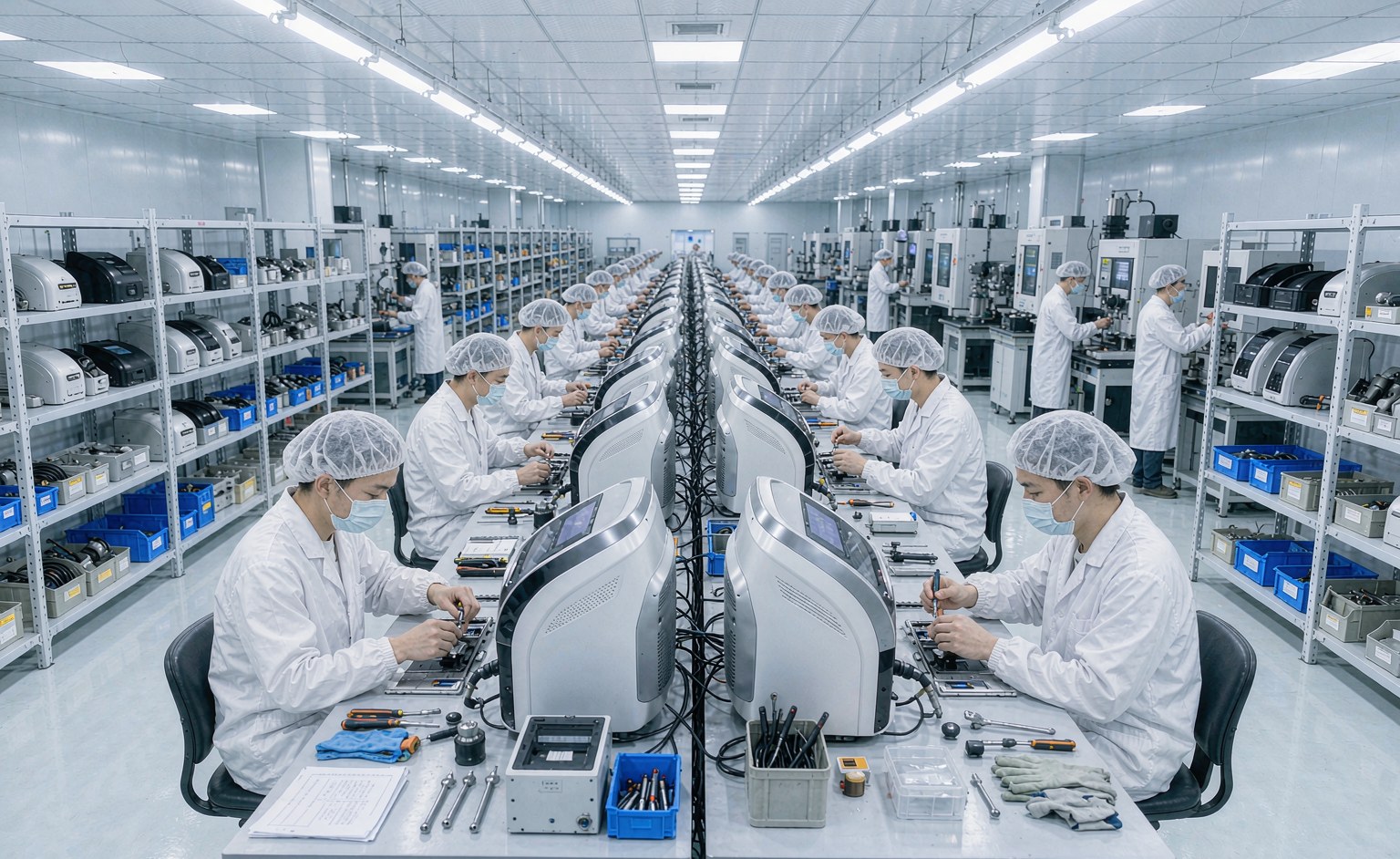
- A live video call is only worth the time if you control the route — ask for the loading dock, the wiring bench, the ageing bay and the QC desk, in that order.
- Video proves existence and activity; it does not prove output quality or what is inside your serial-numbered unit. Add an inspection and an acceptance test later.
- Questions about rejects, serial plates and laser source labels break a staged tour faster than any document check.
- Record the call, log the serial numbers and put one sentence in the purchase order referencing the audit date — otherwise it is just a pleasant conversation.
Almost every factory in this industry will offer you a "live video tour" within one reply. Most of them are theatre: a salesperson walking a fixed route with a phone, showing a clean assembly line and a row of finished machines that have nothing to do with your order. Twenty minutes later you feel reassured and send the deposit.
We sit on the other side of these calls every week, so we will say it plainly: a video call is not a factory tour. It is an interrogation with a camera attached. Run it like an interrogation and it becomes the cheapest due diligence available to a buyer. Run it like a tour and you learn nothing the brochure had not already told you.
Below is the 20-minute agenda we would demand if we were the ones paying, the questions that break a scripted call, and the red flags that only become visible on camera.
What a live video audit can and cannot prove
Video sits in one specific place in your risk stack. It is fast, effectively free, and very good at one job: catching the things that documents cannot hide. It is not a substitute for a pre-shipment inspection and it never replaces a test on your own serial number.
| Evidence | What it proves | What it cannot prove | Cost and time |
|---|---|---|---|
| Live video, your route, unscripted | The plant exists, is running today, and who actually works there | Output quality, or what is inside your specific unit | Free, 20–30 minutes |
| Recorded promo video or drone footage | That somebody owns a camera | Anything about your order | Free |
| Third-party pre-shipment inspection | Your serial number matches the specification and functions | Workmanship habits over months, behaviour when a fault appears | A few hundred USD per man-day |
| On-site visit by you or your agent | Culture, real capacity, housekeeping, the actual people | Still not the unit packed for you, unless you run an acceptance test on it | Flights, days, visas |
Read that table again before your next call. The real value of live video is that it is the only cheap tool that separates a factory from a trading company in a rented conference room, and the only one that shows whether the line is genuinely moving today.
The 20-minute agenda
Send this to the supplier 24 hours before the call. A factory with nothing to hide will follow it, or improve on it. A factory that cannot walk you through its own floor in the order you asked has already answered your most important question.
- 0:00–2:00 — Start at the loading area. Ask for the dock, the packing station, and whatever is crated today. Packing is where weak suppliers get caught: thin foam, no humidity indicator, a plywood case closed with staples.
- 2:00–5:00 — Walk the line front to back, in one shot. Not the showroom. You want the frame assembly area, the wiring benches and the sub-assembly racks, with no cuts between them.
- 5:00–9:00 — Find your machines. If you have an order in production, ask to see the units carrying your order number. How many are on the floor, at what stage, and where are the rest of them?
- 9:00–12:00 — Optics and laser source area. Ask which laser source brand is in this batch, when it arrived, and have one carton opened so the label can be read on camera. That one minute ends most arguments about what is inside the box.
- 12:00–15:00 — Ageing and burn-in bay. Machines running on water chillers. Ask how many hours a unit runs before QC and what the room temperature is. If nothing is ever running, ask why today is different.
- 15:00–17:00 — Run a test on camera with your parameters. Not theirs. Ask them to set the spot size, pulse width and fluence you would use on your own patients, then fire at test material while you watch the screen.
- 17:00–20:00 — Documents on the desk. The serial number plate, the QC test sheet for that serial, the packing list, the certificate covering this exact model, and the name and role of the technician who signed the sheet.
Twenty minutes is enough. What matters is that you controlled the route, not the supplier.
The questions that break a scripted tour
Scripted calls fail on questions the salesperson cannot rehearse. Keep a few of these in your pocket:
- "Turn around and keep walking — what is through that door?" Unannounced direction changes are the fastest test of whether the person on camera actually knows the floor.
- "Who signs the QC sheet — can we meet them?" You want the technician, not the account manager. Testers answer differently from sellers.
- "What is on that pallet, and whose order is it?" Any item you did not plan to see. Borrowed facilities and shared warehouses surface right here.
- "How many units did you reject last month, and why?" Every real factory rejects something. "Zero" means either the question was not understood or QC does not exist.
- "Show me a machine of this model that shipped in the last 30 days." A unit going out of the door tells you more than a demo unit parked in a clean corner.
- "Where do you store laser sources and crystals?" Temperature and humidity control in storage is a genuine engineering signal, not a sales one.
- "Who supplies your chillers, and how long have you used them?" Component supply relationships are hard to invent on a staged tour.
Ask the same question twice, five minutes apart, worded differently. Consistency under pressure is the best single indicator that you are being shown reality.
Red flags in what you see, not what you hear
Everything said on a call is a claim. Everything visible is evidence. Watch for these six:
| What you see | What it usually means | What to do on the spot |
|---|---|---|
| The camera never leaves one room or corridor | The rest is not presentable, or is not theirs | Ask for the loading dock and packing area next |
| Every answer comes from the salesperson before translation even finishes | The technician is not on the call, or is not allowed to speak | Ask the technical team to join for five minutes |
| Machines covered up, or "just moved in" | A rented showroom or a staged set | Ask for the serial plate on one machine and its test sheet |
| A wall of certificates, no visible QC records or calibration area | Certificates belong to a model family, not to your batch | Ask which certificate covers this model number, and in writing |
| A silent production area at 10 a.m. on a weekday | Thin order book, or this is not the site that will build your order | Ask to call back in two days, without warning |
| Your test parameters refused "for safety" | Either a real limitation or the limits are not what was quoted | Ask for the technical reason and the stated maximum, then verify with a sample unit |
One red flag is a question. Two or three on the same call is an answer, and it is not the one you were hoping for.
Turn 20 minutes into a document
A call that was not recorded has roughly the legal weight of a phone conversation. In the disputes we see, the buyer "was shown a clean line" and has nothing to show for it. Fix that before the call starts:
- Record the screen after asking for the supplier's spoken consent at the beginning of the call, and keep the file with the order documents.
- Have the camera read the date and time from a phone or the workshop clock, so the recording is tied to a moment.
- Capture names and roles of everyone on the call, typed into your notes while you watch.
- Note serial numbers of any unit shown against your order, including the machines in the ageing bay.
- File it under the order number — we save ours as supplier-audit-2026-10-16-order-8842.mp4 so it resurfaces exactly when it is needed.
Then put one sentence into the purchase order: "Production to match the conditions shown in the live audit dated [date]", and for repeat orders, "to match the sample as tested". That wording is your own contract adviser's territory — have them review it. What matters is that the audit becomes a reference point instead of an anecdote.
An audit is not the same as an inspection
Buyers often book one and expect the other. A live audit answers: is this a real factory, capable of building my machine? A pre-shipment inspection answers: does this specific serial number match my specification? A factory acceptance test answers: does my unit, run at my parameters, pass?
For a first order, run all three in sequence — the call before the deposit, the inspection before the balance, the acceptance test on the exact serial number. Skip the first step and you may spend money inspecting a carton from a company that never assembles anything itself.
Bottom line
A live video audit is not a courtesy the supplier grants you, it is a test you set. Control the route, ask the questions a sales script cannot survive, refuse a presentation when you asked for a walking tour, and keep the recording with your order file. Twenty minutes of that beats a two-hour polished walkthrough, every single time.
We run these calls with buyers in more than 100 countries and we will run one for you on request — the same agenda, with our technicians in the room and no edits. Book a live factory audit or email gaojiping@xhlmarketing.com with the machine you are considering and the market you sell in. If you want to review specifications first, start with the 4-wavelength diode laser hair removal machine, the CO2 fractional laser system or the picosecond tattoo removal platform.