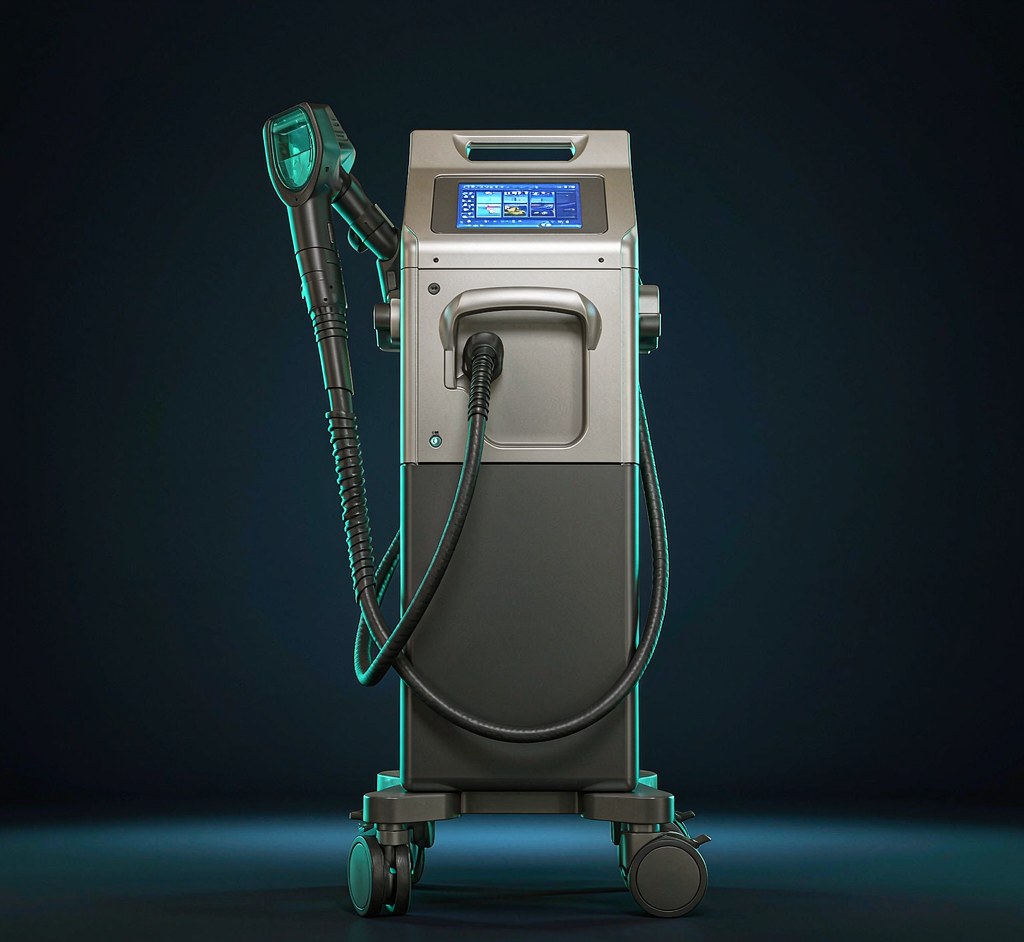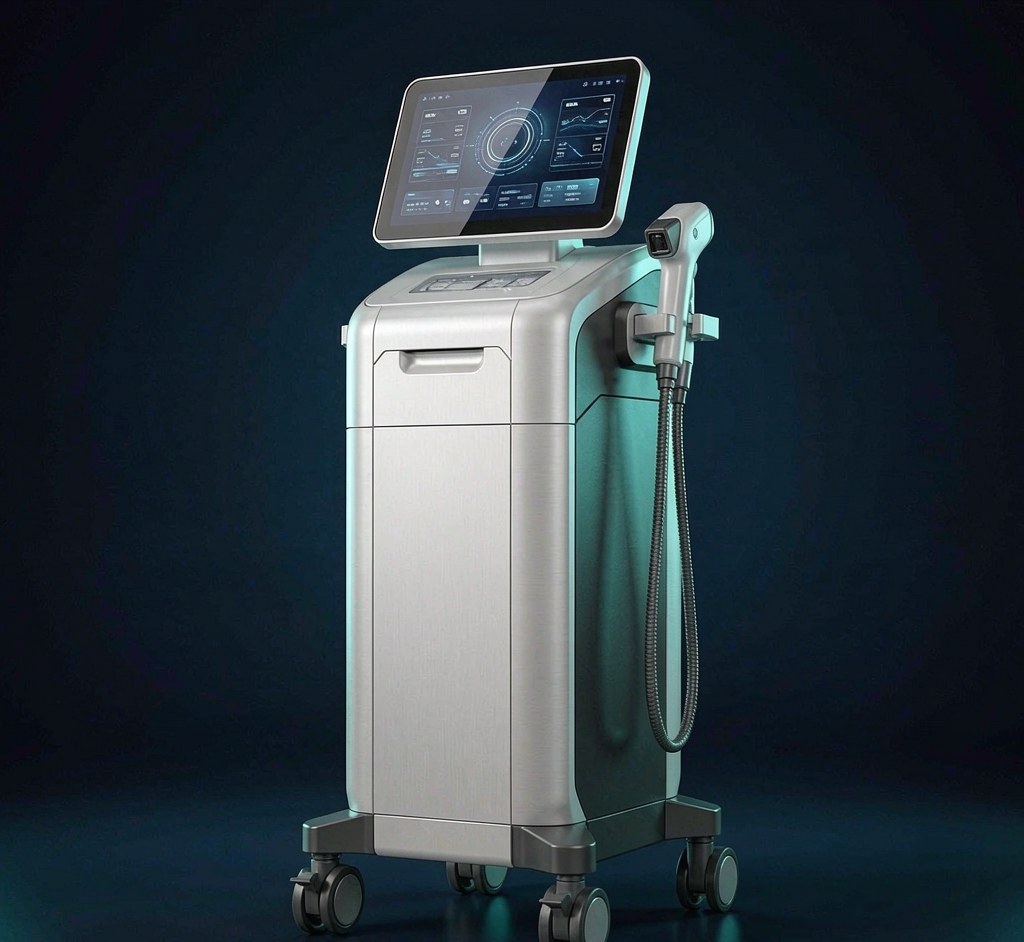
- The wattage on a diode listing should mean the combined optical output of the laser bars. Ask which watts a number refers to, because electrical input is sometimes quoted instead to inflate the figure.
- Watts do not improve clinical results; fluence, pulse width, wavelength and cooling do. Higher power buys speed and consistency: larger spots at real fluence, higher repetition rates, less thermal derating on busy days.
- One question filters every listing: what fluence can the machine hold at your spot size, at a realistic repetition rate, for a 30-minute continuous run — verified on a unit, not on paper.
- 600W fits low-volume start-ups, 1200W is the sweet spot for clinics with routine full-body days, and 2400W only pays when treatment speed is part of what you sell.
Every diode laser hair removal machine listing shouts a wattage. 600W, 1200W, 2400W — and lately we have seen four-figure wattages printed on machines that run from a single wall plug. Buyers read the number like horsepower in a car, and in both directions that reading goes wrong: a well-engineered 600W platform can out-treat a sloppy 1200W one, and paying for 2400W when your schedule will never use it is capital that belongs somewhere else in the business.
We assemble these machines, so this is the version of the wattage conversation we have with buyers who ask us straight: what the number actually measures, what it does not, and which class fits the clinic you are actually running — not the one in the brochure.
What the wattage number actually measures
In a diode system the honest figure is the combined optical output of the laser bars — the semiconductor stacks that generate the beam at 808/810 nm or in a multi-wavelength blend. Their output is combined, homogenized into a uniform spot, and delivered through the handpiece. It is not the electrical draw from the wall: the power supply, the cooling loop and the control electronics all consume additional power, so a machine advertised at 1200W of laser output may pull several times that from the socket depending on efficiency.
Some listings exploit the ambiguity. When a quotation says "watts", ask which watts: optical output of the diode stack, or total electrical input? Both are real numbers, but only one says anything about treatment capability. An electrical figure quoted as laser power is not a typo — it is a deliberate inflation, and it tells you something about the rest of the spec sheet too.
Why more watts does not automatically mean better results
What disables a follicle is not raw power. It is fluence — energy density in J/cm² — delivered over the right pulse width, at the correct wavelength, with the epidermis protected by effective contact cooling. Watts are just joules per second: one input into that chain, not the outcome itself.
Because hair removal uses long pulses, often tens to hundreds of milliseconds, even a modest bar stack can reach treatment fluence on a small spot — given enough pulse duration. A 600W machine can match the per-pulse fluence of a 2400W machine on the same spot size; what it cannot do is get there fast, or hold that output all day without thermal derating. So the real question is never "can it treat?" — it is "at what speed, on what spot size, and for how many hours before the output fades?"
What higher wattage actually buys you
Forget "more powerful". Here is the honest list of what extra optical output pays for:
- Larger spots at adequate fluence. Required energy scales with spot area — doubling the diameter quadruples the joules per pulse. Only a bigger bar stack delivers that without stretching the pulse beyond what the follicle and skin tolerate.
- Higher repetition rate at the same fluence. More joules per second means less waiting between pulses. That is the difference between finishing a full-body session in 45 minutes and spending the whole afternoon on it.
- Less thermal derating. Push any bar stack near its limit and output sags as it heats through the day. A larger stack runs cooler relative to its capability, so the fluence you set at 9 a.m. is the fluence you are still delivering at 6 p.m.
- Cooling headroom. Bar temperature stability drives both output stability and component lifespan. Higher-power platforms normally carry proportionally more cooling capacity — part of what the premium actually buys.
- Room to grow. A larger-spot handpiece, a second treatment room sharing the platform, or added wavelengths in the blend — the power budget is already there.
Not all 600W machines are equal — engineering matters more than the label
Two machines with identical wattage can behave completely differently on a real patient. What separates them:
- Bar quality and count. Reputable bar makers publish lifespans in the tens of millions of shots at rated conditions. Unbranded bars at the same wattage may cost half as much and last a fraction as long.
- Spot homogenization. A flat-top spot delivers uniform fluence across the treatment area; a hot-centered spot risks discomfort at the center and under-treatment at the edges — at the same nominal "fluence".
- Cooling architecture. Compressor-based versus thermoelectric-only, coolant flow design, and condensation control in humid climates all decide whether the machine holds its settings on day 300, not just day 3.
- Skin contact and safety loop. Real-time skin temperature feedback and a handpiece that fails safe are worth more than any wattage figure on the cover page.
This is why we tell buyers to rank sustained fluence at spot size above the wattage figure when comparing quotations — it captures the engineering, while the wattage only captures the arithmetic.
600W vs 1200W vs 2400W: the practical comparison
Exact figures vary by manufacturer and bar configuration, so read this as the pattern we see across the industry rather than one datasheet:
| Attribute | ~600W class | ~1200W class | ~2400W class |
|---|---|---|---|
| Comfortable working spot | 10–12 mm at treatment fluence | 12–15 mm at the same fluence | 15 mm and up at the same fluence |
| Full-body session pace | Workable with deliberate pacing | Rep rate holds at fluence; noticeably faster | Speed becomes a selling point of its own |
| Back-to-back busy days | Most likely to derate as it heats | Generally stable with sound cooling | Runs with headroom; most stable output |
| Best fit | Start-ups, single-room salons, low daily volume | Busy clinics with routine full-body work | High-volume chains and medspas competing on speed |
| Position in range | Entry price tier | Mid tier — the volume sweet spot | Premium tier |
If your day is two or three sessions, the 600W class is not a compromise — it is the right tool, and the capital saved belongs in marketing and operator training. The case for 1200W starts when full-body work becomes routine. The case for 2400W is purely commercial: it pays when treatment speed is part of what you sell, the way an express lane sells speed.
The question to ask instead of "how many watts"
One question cuts through the entire wattage fog, and almost no marketing page answers it unprompted: what fluence can this machine hold at my working spot size, at a realistic repetition rate, continuously for 30 minutes?
A supplier who answers that in writing — and demonstrates it on a unit — has a real machine. One who can only repeat the wattage is selling a number. We recommend verifying on a physical unit before scaling any order; the wattage check itself is simple: an optical power meter behind the handpiece, a sustained run at your working settings, and a look at whether the delivered fluence holds or drifts as the machine heats. Our notes on running a sample unit test cover the whole process.
Red flags in wattage listings
- Only the electrical input power is quoted, dressed up as laser power.
- Fluence figures with no spot size attached — J/cm² is meaningless without an area.
- No bar origin, bar count or cooling architecture anywhere in the spec sheet.
- A four-figure wattage on a portable, single-plug unit. Physics does not negotiate.
- No continuous-run or duty-cycle specification at all.
- Wattage quoted at "peak" with no sustained figure to compare against.
Which class to buy, by business type
- New salon, testing the market: the 600W class. Spend the difference on operator training and customer acquisition — unused headroom markets nothing.
- Established clinic with full-body days several times a week: 1200W. This is where most buyers should land.
- High-volume chain or medspa where speed is the pitch: 2400W — and audit the cooling system as hard as the bar stack, because output sag at 2 p.m. kills the speed pitch faster than anything else.
- Mobile or multi-site operators: weigh power against electrical requirements and machine weight. Check what circuits your clients' premises actually have before falling in love with a big number.
A final note on cross-technology comparisons: the same fluence-first logic applies when weighing diode against alexandrite platforms — we walked through that trade-off in a separate guide. For clinics whose menus extend toward pigmentation or deeper targets, Nd:YAG platforms cover the 1064 nm end of the spectrum, and many established clinics eventually run both alongside their diode workhorse.
Bottom line
Wattage is a capacity number, not a quality number. It determines how fast you can work and how large your spots can be at real fluence — nothing else. Read every spec sheet backwards: fluence at spot size, sustained repetition rate, cooling architecture, and then the wattage as the arithmetic that makes those possible. If you want a second pair of eyes on a quotation before you sign, send it to gaojiping@xhlmarketing.com — we will tell you honestly which class fits your schedule, even when the honest answer is the cheaper machine.